Kallen
Download

Guides

How to free a stiff upper back on your own

Twisting to look behind you in the car meets resistance, and when you try to straighten up the movement happens in your lower back instead of your mid-back. A stiff thoracic spine rarely hurts on its own; the neighbours pay: the neck above it and the lower back below.

What it usually looks like

Stiffness or a dull ache between the shoulder blades after sitting; feels great after stretching or a foam roller "crack"; limited torso rotation (checking blind spots, golf/tennis swings feel wooden). Often paired with neck or shoulder complaints.

Why it happens

The thoracic spine is built to rotate and extend, but a flexed desk shape parks it in one position for years; the joints stiffen, and the neck and lower back start doing its job (and complaining about it). Most "neck" and "lower back" problems keep a stiff mid-back as their quiet accomplice.

Specifics

Clear answers and practical doses

Find specific answers about setup, dosage and timing, with the same numbers shown in the plan further down the page.

01

How do I loosen a stiff upper back at my desk without a foam roller?

Every hour, 20 seconds of standing extension: hands behind your head, look up. It is the first of three self-care rules in the protocol and the simplest: no equipment, no change of clothes. In Kallen, Reverse Sitting can set that hourly rhythm and end each work block with a specific Mobility Snack rather than a bare reminder.

02

What backrest angle stops the upper back from stiffening while I sit?

Slightly reclined, at 100–110°. A rigid 90° parks the thoracic spine in its worst position for the whole workday. It is a setting rather than an exercise, so it works from day one. For the evening, the protocol suggests a foam roller under the mid-back while you watch TV.

03

How long until a stiff upper back loosens up, and how do I stop the stiffness coming back?

Joint stiffness responds fast: most people feel dramatically freer in 2–4 weeks. Keeping it takes the strength phase, 2–3 sessions a week with superman holds of 3 × 20–30 seconds, plus the hourly extension habit. Without both, a month at the desk can erase the gains.

When to see a professional

  • Mid-back pain with fever, night sweats or unexplained weight loss; in-person check soon.
  • Pain that arrived with a fall or impact and hurts on deep breaths; get it checked.
  • New band-like tightness around the chest/abdomen with leg symptoms; professional assessment promptly.

These signs do not mean you must stop moving. Have them assessed in person and continue only with movement that is safe for you.

What you can do from today

  • Break up sitting with 20 seconds of standing extension (hands behind head, look up) every hour.
  • Set the backrest slightly reclined (100-110°); a rigid 90° parks the thoracic spine worst.
  • Foam roller under the mid-back while watching TV: cheap, pleasant, effective.

In Kallen: turn on Reverse Sitting

Start a 25, 45 or 60-minute work block and let Kallen track the time. When it ends, Kallen draws one of 19 Mobility Snacks matched to the tight areas in your profile. Each takes 35–50 seconds; 10 can be done seated and the rest standing beside your desk. Then you return to work.

Your plan, phase by phase

This is how the protocol appears in the app. The coach adapts the pace and dosage to your measurements. You advance when you meet the phase criterion, not when a date arrives.

Phase 1 · 1-3 weeks

Restore motion

Goal

Get the joints moving in extension and rotation again

Dosage

Daily; rotations slow with a full exhale at end range. The roller is a hinge, not a bruiser.

Move on when

Seated rotation visibly improves; the after-work ache fades.

Exercises

Thoracic Extension over RollerChair Thoracic ExtensionOpen BookThread the Needle

Phase 2 · 2-4 weeks

Own the new range

Goal

Strength in the freshly won range so it sticks

Dosage

Wall angels: ribs down, low back quiet; quality reps only, 2x8-10.

Move on when

Wall angels reach higher without arching the lower back.

Exercises

Wall AngelPuppy PoseProne Y-T-WCat-Cow

Phase 3 · 3-6 weeks

Anchor it

Goal

Posterior-chain strength that keeps the mid-back tall all day

Dosage

2-3x/week, 2-3 sets; superman holds 3x20-30s.

Move on when

Rotation tests near-symmetric; desk days stop producing the ache.

Exercises

Band Pull-ApartSuperman HoldBand Row

How long it takes

Joint stiffness responds fast; most people feel dramatically freer in 2-4 weeks. Keeping it needs the strength phase plus the hourly extension habit; otherwise the desk wins it back in a month.

Common questions

How do I test my upper-back mobility?

Sit on a chair, cross your arms over your chest, and rotate your trunk to one side while keeping your hips still. A clear difference between sides, or very little range either way, tells you the rotation is happening somewhere it should not.

Does cracking my back help?

It buys short relief and a feeling of looseness, but it does not durably increase range. What does is regular rotation and extension work plus the strength to hold the new range. Without that, everything returns to baseline within hours.

Is foam rolling worth it?

As preparation, yes: a few minutes on a roller makes it easier to reach a range you are about to use. The roller itself locks in nothing. The value is in what you do in that range immediately afterwards.

Check your own results

Measure your range of motion in Kallen, build your Movement Profile and follow the plan step by step.

Download Kallen
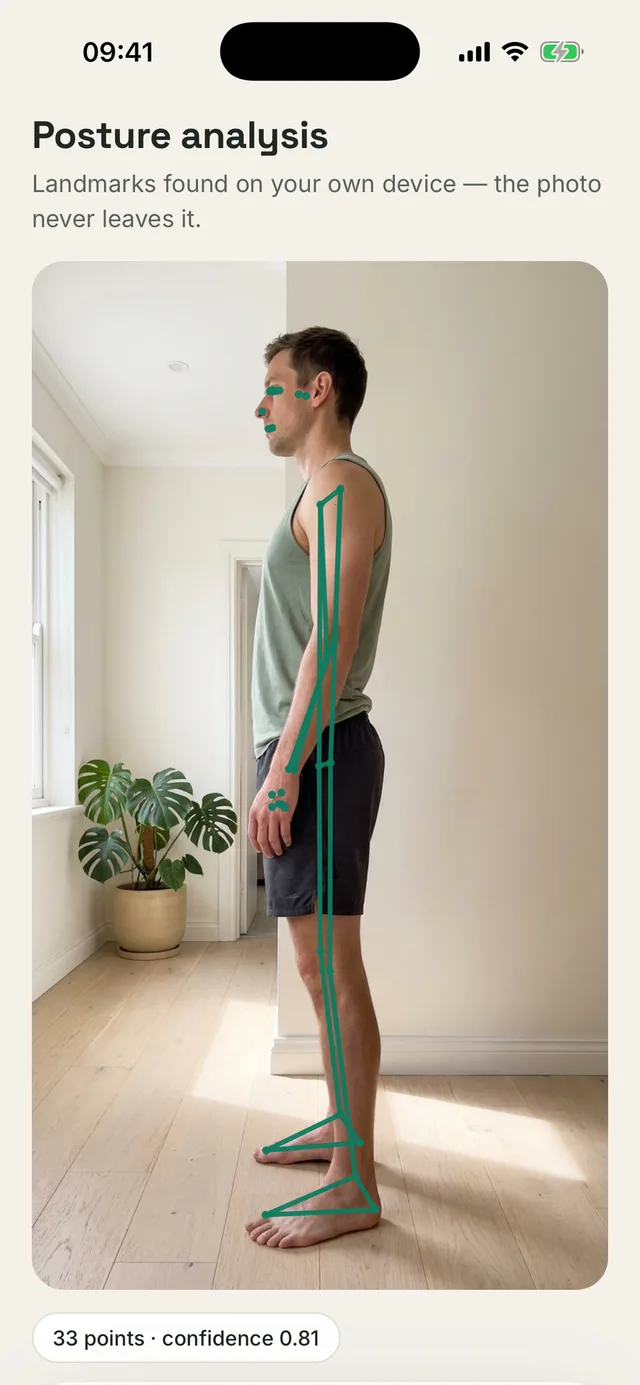
Kallen app screen: a side-on photo with 33 pose landmarks drawn over it and a confidence reading

Posture analysis · side